


















Most employers don't have a hiring problem.
They have a distribution problem.
Posting a job takes five minutes. Getting the right candidates to actually see it is the hard part.
Most "100+ job board" claims sound impressive. The real question is where your job actually appears and whether those candidates convert.
I've made this mistake myself.
Early on, I assumed hiring success came from posting everywhere possible. So I spent time copying the same job description into multiple job boards, tweaking formatting, logging into different employer accounts, and trying to keep applicants organized in a spreadsheet. I wasn't finding better candidates. I was simply creating more administrative work for myself.
That experience changed how I evaluate recruiting software today.
The question isn't whether a platform can post your job to dozens of websites. The question is whether it removes friction between opening a position and making a successful hire.
How can I post a job to multiple job boards at once?
The easiest way to post to multiple job boards is through a recruiting platform like ZipRecruiter, Workable, or JazzHR that distributes a single job posting across dozens of job sites from one dashboard.
Quick verdict
✓ Best for: Employers looking to hire quickly
💰 Typical cost: $75–$400+ per month
⛔ Skip if: You only hire once per year
Throughout this guide, I'll show you when multi-board posting software actually saves time, when manual posting is still the smarter choice, and which recruiting platforms I recommend based on hiring volume rather than marketing claims.
What Does It Mean to Post to Multiple Job Boards?
Posting to multiple job boards means publishing one job and distributing it across several job sites simultaneously.
Instead of logging into multiple employer accounts individually, multi-posting software allows you to create a single job listing and distribute it through one dashboard. Most modern recruiting platforms combine this distribution with applicant tracking, making it easier to advertise openings and manage candidates in the same system.
This is an important distinction.
You're usually paying for convenience and efficiency—not simply access to additional job boards.
Most employers underestimate how much administrative time repetitive posting creates. If you're hiring several employees each year, eliminating those repetitive tasks quickly becomes valuable.
Direct Posting vs. Job Board Syndication
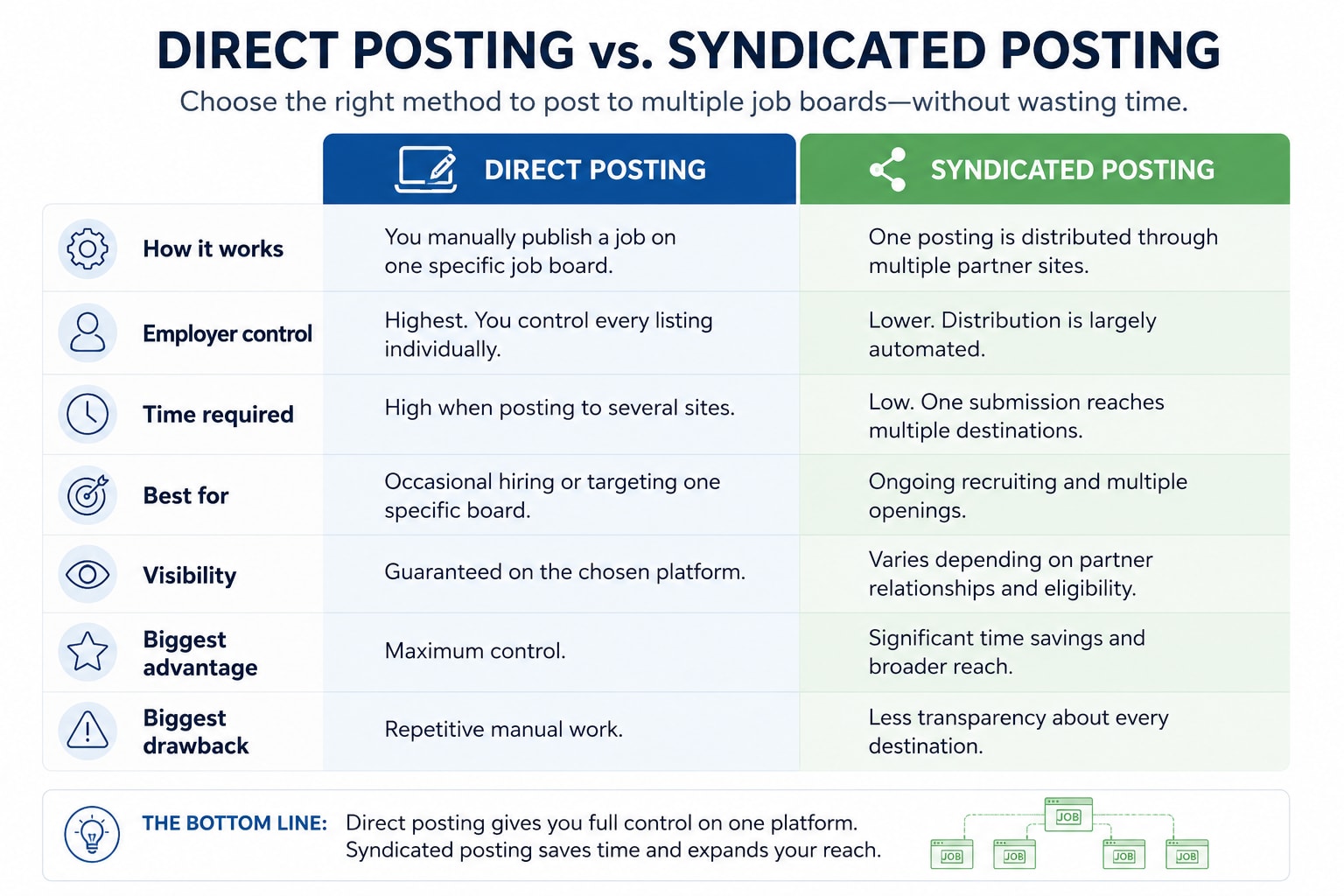
Direct posting places a job on a specific job board, while syndication distributes it through partner networks automatically.
Although employers often use these terms interchangeably, they produce different results.
With direct posting, you intentionally publish your opening on an individual platform. Your visibility depends on that platform's own search algorithms, sponsored listings, and employer tools.
With syndication, recruiting software sends your listing through a network of integrations and publishing partners. Where your job ultimately appears depends on the platform's relationships, your job type, your location, and eligibility requirements.
Here's how they compare.
CareerCloud Insight
Many employers assume posting to more job boards automatically produces better candidates.
It doesn't.
Distribution increases visibility—not applicant quality.
Your job description, salary competitiveness, employer reputation, interview speed, and communication all have a greater impact on whether qualified candidates apply than simply appearing on more websites.
That's why I encourage employers to evaluate recruiting platforms based on hiring outcomes instead of marketing numbers.
More job boards don't automatically create better hires. Better hiring processes do.
Is Posting to Multiple Job Boards Worth It?
Posting to multiple job boards is usually worth the cost when hiring volume or time savings justify the monthly fee.
For many employers, the decision isn't really about software.
It's about leverage.
Hiring one employee every few years is very different from filling multiple positions every quarter. The value of recruiting software increases as hiring becomes a recurring business activity rather than a one-time project.
This is another place where I see founders overcomplicate the decision.
Some buy enterprise recruiting software far too early.
Others continue posting manually long after the administrative burden has become obvious.
Neither approach is ideal.
When Manual Posting Makes Sense
Manual posting makes sense when hiring is infrequent and simplicity matters more than automation.
Manual posting is usually the better choice if you:
- Hire one employee each year
- Have a very limited recruiting budget
- Primarily recruit locally
- Already know exactly which job board performs best for your business
For many small employers, manually posting once each year is perfectly reasonable.
There's no reason to pay hundreds of dollars each month for software that sits unused.
When Distribution Software Makes Sense
Distribution software makes sense when recruiting becomes a repeatable business process rather than an occasional task.
As hiring volume increases, administrative work compounds.
Writing job descriptions.
Posting jobs.
Managing applicants.
Scheduling interviews.
Tracking communication.
Following up.
These tasks quickly consume hours that founders could spend serving customers or growing the business.
That's where recruiting platforms begin paying for themselves.
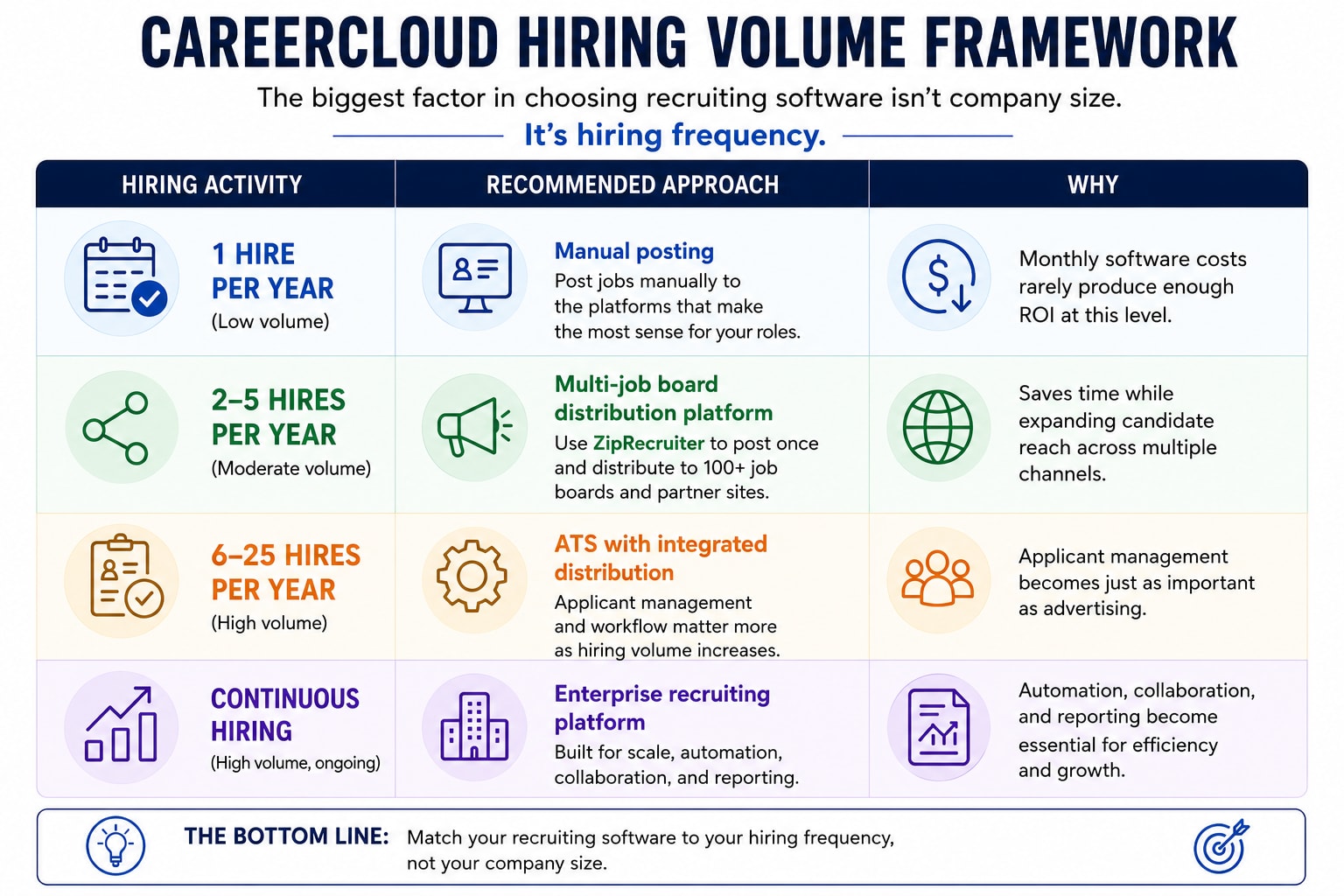
CareerCloud Hiring Volume Framework
The biggest factor in choosing recruiting software isn't company size.
It's hiring frequency.
CareerCloud Take
Most employers buy recruiting software too early or too late.
If hiring is occasional, keep it simple.
Once you're filling multiple positions every year, buying back your recruiting time becomes more valuable than saving money on software.
Your first recruiting platform isn't really a software purchase. It's a time purchase.
If you’re new to the hiring process, check out our guide on how to hire your first employee.
Best Tools to Post to Multiple Job Boards
ZipRecruiter is our top recommendation for employers looking to hire quality candidates.
Not every recruiting platform solves the same problem.
Some focus almost entirely on getting your job in front of more candidates. Others are built around applicant tracking, interview collaboration, reporting, and long-term recruiting operations.
That's why we don't rank hiring software based on feature count alone.
At CareerCloud, we evaluate recruiting platforms based on one question:
Which employer is most likely to make a successful hire using this platform?
Pricing, applicant tracking, ease of use, hiring speed, and employer fit all matter. A platform with twice as many features isn't automatically twice as valuable.
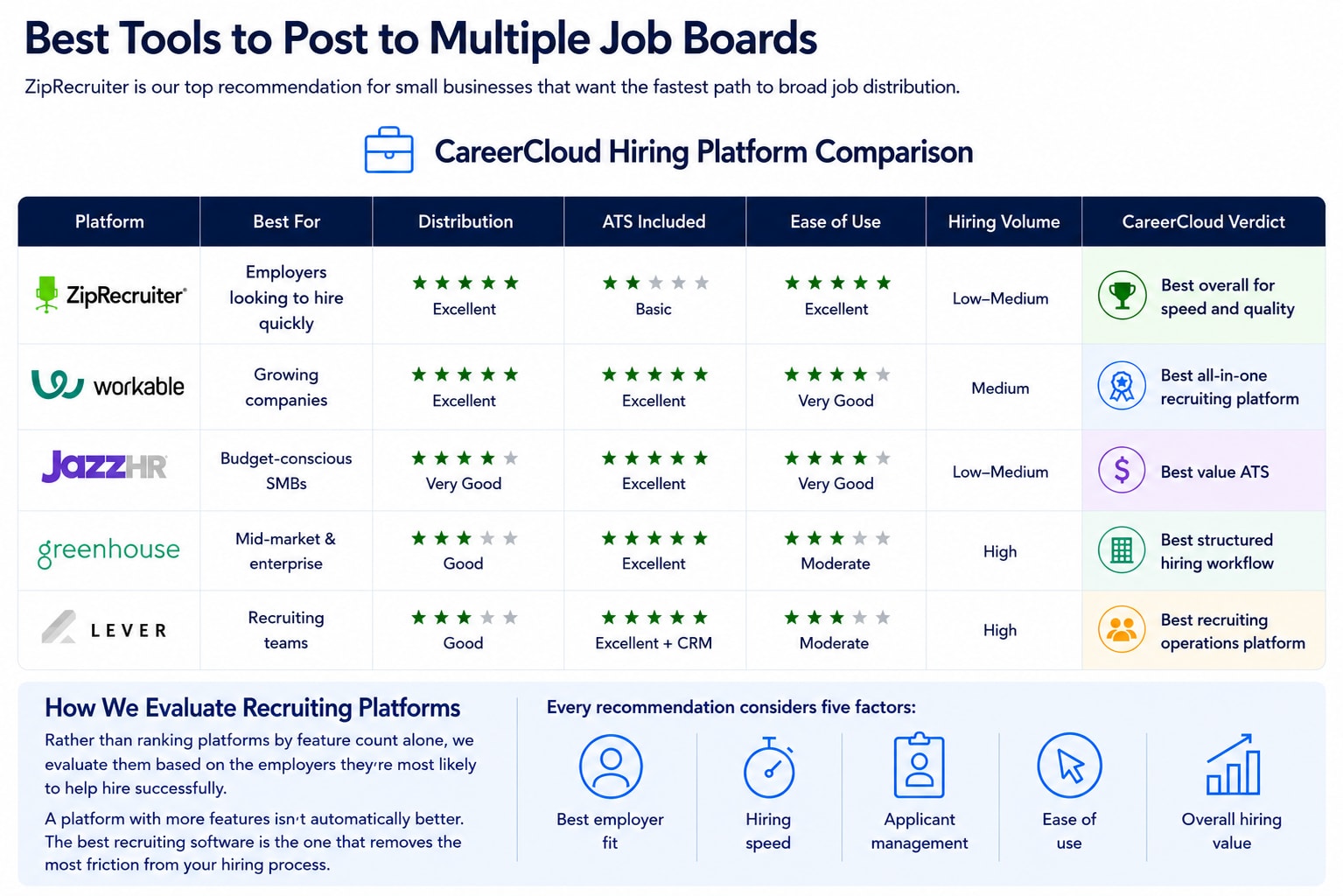
CareerCloud Hiring Platform Comparison
How We Evaluate Recruiting Platforms
Rather than ranking platforms by feature count alone, we evaluate them based on the employers they're most likely to help hire successfully.
Every recommendation considers five factors:
- Best employer fit
- Hiring speed
- Applicant management
- Ease of use
- Overall hiring value
A platform with more features isn't automatically better.
The best recruiting software is the one that removes the most friction from your hiring process.
ZipRecruiter
ZipRecruiter is the #1 rated hiring site according to G2.
If you only remember one recommendation from this guide, it's this one.
For most employers hiring multiple employees each year, ZipRecruiter strikes the best balance between simplicity, distribution, speed and quality.
That's an important distinction.
Why We Recommend ZipRecruiter
ZipRecruiter makes it easy to reach millions of candidates and advertise jobs broadly without adding administrative work.
The platform sends jobs to 100+ job boards with one click, while allowing employers to manage applicants from one dashboard.
Its candidate matching technology also recommends qualified candidates based on your job requirements rather than relying exclusively on candidates finding your posting themselves.
For founders wearing multiple hats, that simplicity matters.
I also like that the employer workflow is approachable. You don't need an HR department to understand how the system works.
That's exactly who the platform was built for.
Biggest Tradeoffs
ZipRecruiter isn't the best choice for every employer.
Pricing varies depending on the size of the employer and number of job slots.
Pricing
ZipRecruiter offers subscription-based pricing as well as pay-per-post pricing.
Pricing is predictable and does not change based on the number of clicks or applications your job receives.
Enterprise pricing is available for organizations with larger recruiting needs.
CareerCloud Verdict
🟢 Overall Recommendation: Highly Recommended
👤 Best For: Employers hiring multiple employees each year
🎯 Also Available: Enterprise hiring, executive search solutions, and tailored pricing through ZipRecruiter's sales team for organizations with more specialized recruiting needs.
⚡ Biggest Advantage: Fast job distribution, AI-powered candidate matching, and flexible hiring options—including tailored pricing based on your hiring needs.
💡 Good to Know: ZipRecruiter offers customized pricing through its sales team, including options for employers hiring for a single position or those with enterprise recruiting requirements.
Most employers think recruiting software exists to post jobs. It doesn't. It exists to shorten the distance between an open role and a great hire.
For more information, check out our ZipRecruiter review.
Workable
Workable is best for growing companies that need both recruiting software and job distribution.
If ZipRecruiter is optimized for speed, Workable is optimized for process.
As hiring becomes more frequent, simply posting jobs isn't enough. You also need interview workflows, hiring collaboration, applicant pipelines, and reporting.
That's where Workable shines.
Why We Recommend It
Workable combines a robust applicant tracking system with strong multi-board distribution.
Instead of stitching together multiple tools, employers can manage sourcing, interviewing, evaluations, and hiring from one platform.
Growing companies often reach this point faster than expected.
Once multiple managers are involved in hiring decisions, organization becomes just as valuable as visibility.
Biggest Tradeoffs
Workable costs more than many entry-level recruiting tools.
For employers hiring only a few positions each year, many of its advanced features will never be used.
The platform also has a steeper learning curve than ZipRecruiter simply because it does much more.
Pricing
Workable offers multiple subscription tiers based on hiring needs and company size.
Pricing changes periodically, so verify current plans on Workable's official pricing page before purchasing.
CareerCloud Verdict
🟢 Overall Recommendation: Highly Recommended
👤 Best For: Growing teams that want both applicant tracking and broad job distribution in one platform.
🚫 Skip If: Your top priority is finding the lowest-cost recruiting software.
⚡ Biggest Advantage: Excellent ATS capabilities combined with broad multi-job-board distribution.
⚠️ Biggest Drawback: Pricing increases as your hiring volume and recruiting needs grow.
Bottom Line
If you're ready to move beyond basic job posting software, Workable is one of the strongest all-in-one recruiting platforms available. It combines powerful applicant tracking with excellent job distribution, making it an excellent choice for growing businesses that plan to hire consistently rather than occasionally.
JazzHR
JazzHR is best for budget-conscious small businesses that want ATS functionality and job distribution.
JazzHR fills an interesting position in the recruiting software market.
It offers much of the applicant tracking functionality growing employers need without the complexity—or cost—of enterprise recruiting platforms.
Why We Recommend It
JazzHR delivers strong hiring functionality at a price that's approachable for many small businesses.
The platform includes applicant tracking, interview workflows, job distribution, and collaboration tools while remaining relatively easy to learn.
For employers making several hires each year, it's an excellent value.
Biggest Tradeoffs
JazzHR has a smaller ecosystem than some competitors.
Large organizations needing sophisticated automation, advanced analytics, or complex recruiting operations may eventually outgrow the platform.
Pricing
JazzHR offers tiered subscription pricing based on included recruiting features.
Always verify current pricing directly through JazzHR because plans and promotional offers change periodically.
CareerCloud Verdict
🟢 Overall Recommendation: Recommended
👤 Best For: Small and midsize businesses that want an affordable applicant tracking system with built-in job distribution.
🚫 Skip If: You need enterprise-level recruiting workflows, advanced reporting, or highly customizable hiring processes.
⚡ Biggest Advantage: Strong applicant tracking features at a lower overall cost than many competitors.
⚠️ Biggest Drawback: The platform has a smaller integration ecosystem and fewer advanced capabilities than enterprise recruiting platforms.
Bottom Line
If you're a small or midsize business that wants more organization than manual hiring without paying enterprise software prices, JazzHR delivers excellent value. It combines solid applicant tracking with multi-job-board posting, making it a smart choice for growing teams that want to improve their hiring process without overcomplicating it.
Greenhouse
Greenhouse is best for larger organizations that need structured hiring workflows and recruiting automation.
Greenhouse has become one of the most recognizable applicant tracking systems in enterprise recruiting, and for good reason. Rather than focusing primarily on job distribution, it focuses on helping hiring teams make more consistent, data-driven hiring decisions.
If your recruiting process involves multiple interviewers, scorecards, approvals, and standardized hiring practices, Greenhouse deserves a serious look.
Why We Recommend It
Greenhouse excels at creating a structured hiring process across an entire organization.
Features like interview scorecards, approval workflows, candidate evaluation templates, and detailed reporting help reduce inconsistency between hiring managers.
That's especially valuable once you're hiring dozens—or hundreds—of employees each year.
Structure creates better hiring decisions.
Biggest Tradeoffs
Greenhouse is more software than most small businesses need.
The implementation process takes longer than platforms built for smaller employers, and many of its advanced features won't provide meaningful value if you're only hiring a handful of employees annually.
It also represents a larger financial investment than platforms designed for SMBs.
Pricing
Greenhouse provides custom pricing based on company size and recruiting needs.
Because pricing is customized, you'll need to request a quote directly from Greenhouse.
CareerCloud Verdict
🟢 Overall Recommendation: Recommended
👤 Best For: Mid-market and enterprise organizations that need structured hiring processes and collaborative recruiting.
🚫 Skip If: You're a small business making occasional hires or want the simplest, lowest-maintenance hiring solution.
⚡ Biggest Advantage: Sophisticated hiring workflows, structured interviewing, and powerful collaboration tools for larger recruiting teams.
⚠️ Biggest Drawback: The platform is more complex and significantly more expensive than most small businesses need.
Bottom Line
Greenhouse is one of the strongest recruiting platforms for organizations with dedicated hiring teams and a consistent recruiting pipeline. If your company values structured interviews, hiring consistency, and collaboration across multiple stakeholders, it's an excellent choice. For small businesses hiring only a few employees each year, however, the added complexity and cost are difficult to justify.
Lever
Lever is best for recruiting teams that want CRM functionality combined with applicant tracking and job distribution.
Lever approaches recruiting differently than most applicant tracking systems.
Instead of viewing hiring as a series of individual job openings, it treats recruiting as an ongoing relationship-building process.
That distinction matters for organizations recruiting continuously.
Why We Recommend It
Lever combines applicant tracking with candidate relationship management (CRM).
Recruiters can build long-term talent pipelines, nurture passive candidates, and maintain communication even before a position officially opens.
For organizations competing for specialized talent, those relationships often become a competitive advantage.
Recruiting doesn't start when a job opens.
It starts long before that.
Biggest Tradeoffs
Lever offers more functionality than most small employers require.
If you're only hiring a few people each year, maintaining talent pipelines and CRM workflows probably isn't worth the additional complexity.
Many founders simply won't use those features.
Pricing
Lever provides customized pricing based on organization size and hiring requirements.
Request current pricing directly from Lever because public pricing isn't generally available.
CareerCloud Verdict
🟢 Overall Recommendation: Recommended
👤 Best For: Recruiting teams with ongoing hiring needs that want to build long-term candidate relationships.
🚫 Skip If: You're making occasional one-off hires and don't need advanced recruiting software.
⚡ Biggest Advantage: Combines a powerful applicant tracking system with built-in candidate relationship management (CRM).
⚠️ Biggest Drawback: The platform offers more functionality than most small businesses need, making it harder to justify for simple hiring.
Bottom Line
Lever is built for organizations that treat recruiting as an ongoing process rather than a series of individual hires. Its combination of ATS and CRM tools makes it a strong choice for companies that want to build talent pipelines and nurture candidates over time. If you're only filling a position once or twice a year, a simpler platform will likely be a better fit.
Does ZipRecruiter Really Post Jobs to 100+ Job Boards?
ZipRecruiter distributes jobs through a combination of direct integrations and syndication partners rather than guaranteeing placement on every board.
This is probably the biggest question employers have after seeing ZipRecruiter's marketing.
The short answer is yes—ZipRecruiter sends jobs to 100+ job boards with one click. They have 20M job seekers using the platform on a monthly basis and have delivered over 40M great match candidates in 2025.
What Counts as a Direct Integration?
Direct integrations publish jobs directly to participating job boards.
These relationships allow recruiting platforms to send job postings straight to participating employment websites.
Exactly which boards participate can change over time as partnership agreements evolve.
Direct integrations generally provide more predictable placement because the relationship exists between the recruiting platform and the destination site.
What Counts as Syndication?
Syndication distributes job postings through publishing partners rather than direct employer submissions.
In these situations, your job may appear across additional employment websites through partner relationships rather than direct publishing.
Whether a particular job appears depends on several factors, including:
- Job type
- Geographic location
- Distribution settings
- Partner eligibility
- Individual publishing agreements
This explains why two employers using the same recruiting platform may not see identical distribution.
What Employers Should Realistically Expect
Employers should expect broader reach—not guaranteed placement everywhere.
One of the biggest misconceptions in recruiting software is that more job boards automatically produce better hiring outcomes.
They don't.
Visibility helps.
Qualified candidates still need to:
- Find your posting.
- Understand the opportunity.
- Apply.
- Complete your hiring process before accepting another offer.
Distribution solves only the first step.
Everything after that still depends on your hiring process.
CareerCloud Insight
The number of job boards isn't the metric that matters.
Qualified candidates only apply if they actually see your posting, understand the opportunity, and move through your hiring process quickly.
Distribution creates opportunity. Your hiring process determines whether that opportunity becomes a successful hire.
Our Recommendation by Hiring Situation
The best platform depends more on hiring volume than company size.
This is the biggest takeaway I hope you leave with.
I see too many employers compare recruiting software the same way they compare laptops or accounting software. They build feature checklists, compare pricing, and assume the platform with the most capabilities must be the best choice.
That's rarely how hiring works.
The right recruiting platform is the one that removes the biggest bottleneck in your hiring process.
For some employers, that's simply getting more visibility.
For others, it's managing hundreds of applicants.
For larger organizations, it's creating a repeatable hiring system that every manager follows.
Your hiring volume should drive the decision.
Here's how I think about each situation.
Hiring one role each year
Keep it simple.
If you only hire occasionally, you probably don't need a monthly recruiting platform.
Posting directly on job boards takes more time, but if you're doing it once every year or two, that extra effort is usually worth the savings.
Don't buy software you'll barely use.
Hiring two to five employees annually
This is where ZipRecruiter starts making a lot of sense.
Once hiring becomes a recurring activity instead of a one-time event, the time you save from centralized job distribution often outweighs the monthly subscription cost.
You're buying back hours you would otherwise spend posting jobs, organizing applicants, and managing hiring manually.
That's leverage.
Hiring continuously
Move beyond simple job distribution.
If recruiting has become an ongoing part of your business, applicant tracking and collaboration matter just as much as advertising.
Platforms like Workable, Greenhouse, and Lever help create hiring systems rather than simply posting jobs.
That becomes increasingly valuable as more managers become involved in recruiting decisions.
Need applicant tracking plus distribution
Choose Workable.
Among the platforms covered in this guide, I think Workable strikes one of the best balances between applicant tracking, collaboration, and multi-board distribution for growing companies.
It offers enough sophistication to grow with your business without becoming overwhelming for smaller teams.
Most founders don't need more hiring software. They need software that removes one bottleneck at a time.
Frequently Asked Questions
How can I post a job to multiple job boards at once?
The easiest way to post to multiple job boards is through recruiting software that distributes one job listing across multiple destinations from a single dashboard, like ZipRecruiter.
Does ZipRecruiter really post jobs to 100+ job boards?
Yes, ZipRecruiter distributes jobs through a network of direct integrations and syndication partners. Placement can vary based on the job, location, and distribution settings.
What is the best way for a small business to post jobs online?
Small businesses hiring a few positions per year typically benefit most from a platform that combines job distribution, applicant tracking, and candidate management in one place.
Is posting to multiple job boards worth paying for?
Multi-board posting is usually worth the cost when the time savings and expanded reach exceed the monthly subscription fee.
What's the difference between direct posting and job board syndication?
Direct posting places a job on a specific site, while syndication distributes the job through partner networks that may place it on multiple sites automatically.
Final Thoughts
Most small businesses don't need more hiring software.
They need a faster path between an open role and the right candidate.
That's why I encourage employers to stop comparing recruiting platforms based solely on how many job boards they claim to reach. A bigger distribution network doesn't automatically lead to better hires.
Instead, ask a simpler question:
Will this platform help me find qualified candidates faster while reducing the manual work involved in hiring?
For many small businesses, that's exactly where ZipRecruiter stands out.
It combines broad job distribution, AI-powered candidate matching, and a hiring workflow that's simple enough for employers who don't have a dedicated recruiting team. Rather than logging into multiple sites and managing separate postings, you can spend more time evaluating candidates and less time managing the hiring process.
Manual posting can still make sense if you're hiring occasionally and have plenty of time. But once recruiting becomes a recurring part of running your business, the time savings alone often justify investing in a platform designed to streamline the process.
Because hiring isn't about posting to the most job boards.
It's about removing friction between the right opportunity and the right candidate.
If you're planning to hire multiple employees this year, ZipRecruiter is where I'd start. It consistently offers the best combination of reach, ease of use, and hiring efficiency for most small businesses, making it the strongest overall choice for employers who want to spend less time posting jobs and more time making great hires.


