


















Most employers think they have a candidate shortage.
The truth is they usually have a visibility problem.
Posting a job doesn't create applicants. Positioning your opportunity and distributing it effectively does.
Most businesses don't lose candidates because they pay less. They lose candidates because better employers make the decision easier.
I've seen employers spend weeks rewriting job descriptions, increasing salaries, and blaming the labor market when the real issue was much simpler.
Qualified candidates never knew the opportunity existed.
That distinction matters because it changes where you spend your time and money.
Before you increase compensation or hire a recruiter, ask yourself one question:
How many qualified people have actually seen your job posting?
If the answer is "I'm not sure," you're guessing.
And hiring based on guesses gets expensive quickly.
At CareerCloud, we've reviewed hundreds of hiring platforms and recruiting strategies. One lesson keeps repeating itself: employers who diagnose the real bottleneck before changing their hiring strategy almost always make better hiring decisions.
Sometimes you need better compensation.
Sometimes you need a stronger employer brand.
Sometimes you simply need more qualified people to see your opening.
Knowing which problem you're solving is the advantage.
Why is it so hard to find employees in a competitive job market?
Most employers are competing for the same candidates. The challenge is often visibility and positioning, not a lack of available workers.
Quick Verdict
- Best approach: Improve job attractiveness first, then improve distribution.
- Biggest mistake: Assuming no qualified candidates exist.
- Skip: Posting once and waiting.
- Alternative: Referrals, niche communities, workforce development boards, and targeted recruiting channels.
Why Finding Employees Feels Harder Than Ever
Finding employees feels harder because candidates have more options and employers face more competition for attention.
The labor market has shifted over the past several years, but one reality has remained consistent: qualified candidates have more information and more choices than ever before. According to the U.S. Bureau of Labor Statistics Job Openings and Labor Turnover Survey (JOLTS), millions of job openings continue to exist across the U.S., even as hiring rates fluctuate.
Most employers interpret this as a candidate shortage.
I don't.
I see a competition problem.
Candidates compare employers the same way consumers compare products. Within minutes they can evaluate pay, flexibility, company reputation, reviews, commute, and career growth before deciding whether to apply.
That competition is real. According to ZipRecruiter Economic Research, 28.2% of job seekers reported receiving multiple job offers in its Q1 2026 Job Seeker Confidence Survey. The survey included a nationally representative sample of 1,500 active U.S. job seekers.
Your job posting isn't competing against unemployment.
It's competing against every other opportunity a qualified candidate sees that day.
That's why visibility matters.
A great opportunity no one sees produces the same hiring result as a terrible opportunity everyone ignores.
Candidate Shortage vs. Visibility Problem
Many hiring challenges are visibility problems disguised as candidate shortages.
One of the most common hiring mistakes I see is assuming there aren't qualified candidates available when, in reality, very few qualified people have ever seen the position.
That changes everything.
Before worrying about interview questions or recruiting software, you first need enough qualified people entering the top of your hiring funnel.
The Society for Human Resource Management (SHRM) has consistently reported that employers face increasing competition for talent—not simply because workers disappeared, but because candidates have more employment options and greater expectations around flexibility, compensation, and workplace culture.
Most employers don't have a candidate shortage. They have a visibility problem.
That's an important reframe.
Because visibility problems have very different solutions than candidate quality problems.
If visibility is the issue, improving job distribution may solve it.
If positioning is the issue, rewriting the opportunity may solve it.
If competitiveness is the issue, only improving your offer will.
Diagnose first.
Then optimize.
Start With the CareerCloud Competitive Hiring Audit
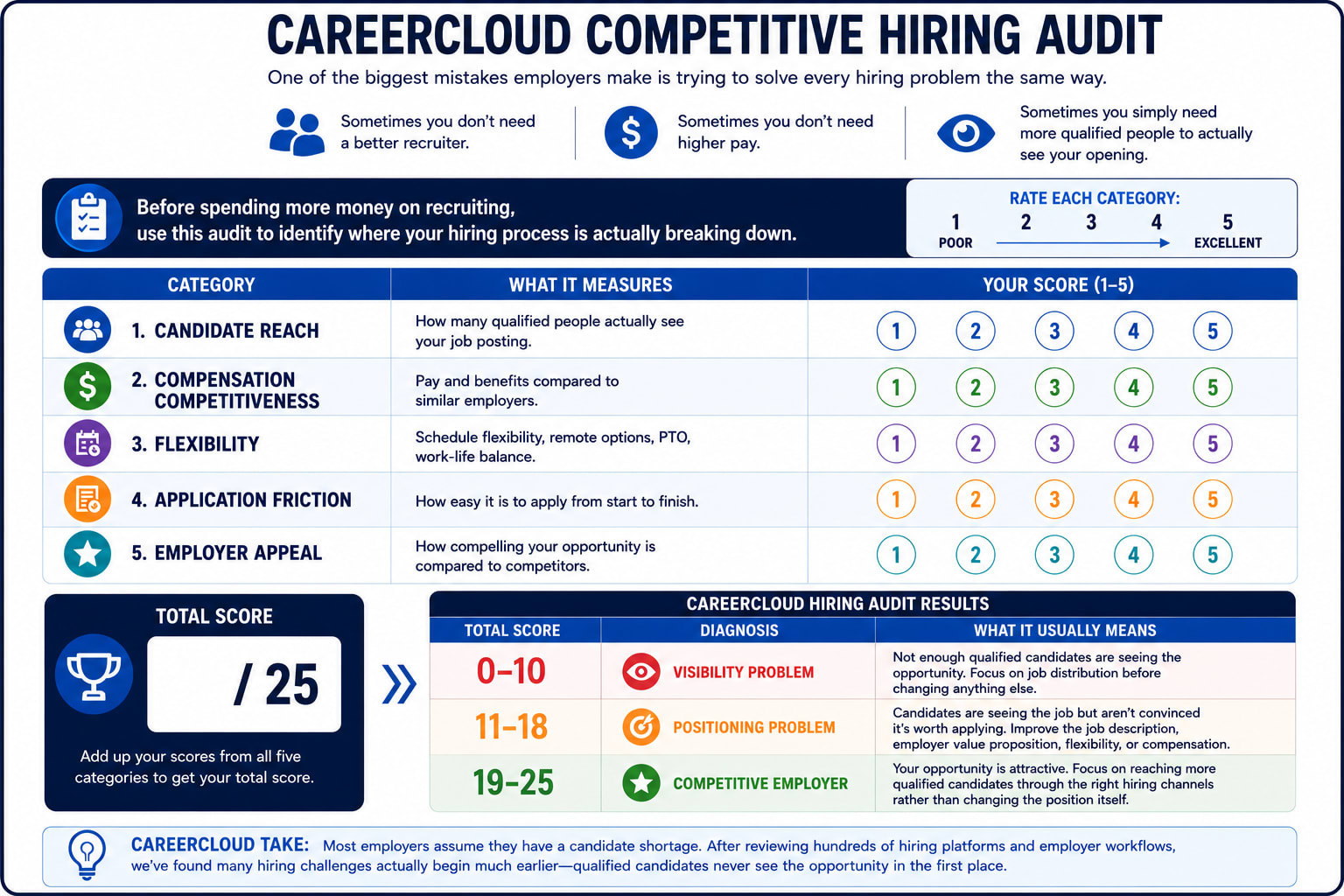
The fastest way to improve hiring results is to identify whether you have a visibility problem, positioning problem, or competitiveness problem.
One of the biggest mistakes employers make is trying to solve every hiring problem the same way.
Sometimes you don't need a better recruiter.
Sometimes you don't need higher pay.
Sometimes you simply need more qualified people to actually see your opening.
Before spending more money on recruiting, use this audit to identify where your hiring process is actually breaking down.
Rate each category from 1 (poor) to 5 (excellent).
Candidate Reach
If qualified candidates never see your opening, nothing else matters.
Hiring starts with awareness.
If only a handful of qualified people ever encounter your posting, it doesn't matter how compelling your benefits package is or how efficient your interview process becomes.
No visibility means no applicants.
Before changing compensation, ask yourself where your job is actually being distributed.
If you're posting to a single job board and waiting, you've likely identified your first bottleneck.
Compensation Competitiveness
Compensation affects hiring, but it is only one factor candidates evaluate.
Competitive pay matters.
There's no way around that.
But compensation rarely operates in isolation. Candidates compare salary alongside healthcare, retirement benefits, flexibility, advancement opportunities, commute, company reputation, and overall quality of life. For employers using ZipRecruiter, there’s also a measurable benefit to including pay: job posts on ZipRecruiter that list salary information are nearly 3x more likely to deliver quality candidates. (Disclaimer: ZipRecruiter Internal Data, 2025 average.)
A slightly lower salary paired with meaningful flexibility can outperform a higher-paying opportunity with rigid scheduling.
Furthermore, 27.1% of job seekers would feel more seen if employers provided salary transparency upfront. As most (56.9%) recent new hires accepted their role because of the pay, aligning early on about salary expectations can help move faster later on in the process, according to ZipRecruiter.
Flexibility
Flexibility often increases applicant volume more than employers expect.
The definition of flexibility has expanded well beyond remote work.
Compressed workweeks.
Flexible scheduling.
Additional paid time off.
Predictable shifts.
Hybrid options.
These factors influence candidate decisions every day, especially in competitive labor markets where multiple employers offer similar compensation.
More than that, just under half (49.5%) of job seekers who have rejected a role rejected it because it lacked the flexibility they needed. Employers should highlight specific scheduling options and explain what those benefits mean for candidates during the application process. This circles back to the importance of building trust through clarity.
Application Friction
Every additional application step reduces completion rates.
ZipApply jobs receive over 2.5 more candidates. (Disclaimer: ZipRecruiter Internal Data, 2025 average.)
ZipApply by ZipRecruiter is a one-click job application feature. It lets job seekers apply for open roles using their saved profile and resume without leaving the platform or being redirected to an external company website.
Long applications don't screen better candidates.
They eliminate applicants.
If candidates need to create an account, upload a resume, manually enter the same information, complete lengthy assessments, and answer dozens of questions before speaking with anyone, many qualified people will simply move on to another employer.
Reducing friction is often one of the fastest hiring improvements you can make.
Employer Appeal
Candidates choose employers that clearly communicate why the opportunity matters.
Job descriptions often read like legal documents.
Our research indicates that 46.7% of job seekers would feel more seen by employers if job descriptions were more detailed, helping them narrow down which jobs are aligned with their skills and interests. Lacking clarity in job descriptions can take a toll on all parties in the job search. A lack of clarity is a primary reason for offer rejections, with 21.4% of job seekers who rejected an offer saying they did so because the job duties were unclear - a preventable outcome.
That's a missed opportunity.
The strongest hiring messages explain why someone should join your company—not just what they'll be expected to do.
Candidates don't simply evaluate responsibilities.
They evaluate whether your opportunity is worth leaving their current one.
Diagnose the Real Problem Before Changing Your Hiring Strategy
Most hiring fixes fail because employers solve the wrong problem.
One of the biggest reasons employers waste time and money is that they jump straight to a solution before identifying the bottleneck.
Applications are slow?
Buy another recruiting tool.
Candidates decline offers?
Raise the salary.
Not enough interviews?
Rewrite the job description.
Sometimes those changes help.
Often they don't.
Hiring works like any other funnel. Until you know where candidates are dropping out, you're making expensive guesses.
That's why I recommend walking through this simple diagnostic before changing your hiring strategy.
Visibility vs. Candidate Shortage Diagnostic

The goal isn't to memorize the framework.
The goal is to stop treating every hiring challenge like the same problem.
Once you identify the bottleneck, your next step usually becomes obvious.
Distribution Problem
A distribution problem occurs when too few qualified candidates ever see your job.
This is the hiring problem I see most often.
Employers assume there aren't qualified candidates available when the real issue is that their posting reached a very small audience.
Typical symptoms include:
🔴 Distribution Problem
Symptoms
- Very few applicants
First fix
- Expand job distribution and recruiting channels
This is where broad-distribution hiring platforms, employee referrals, local workforce development organizations, and industry communities make the biggest difference.
Posting once isn't a distribution strategy.
It's wishful thinking.
For more information, check out our guide on how to post to multiple job boards.
Friction Problem
A friction problem occurs when candidates start but do not complete applications.
Sometimes employers successfully attract candidates but lose them before the application is submitted.
That usually points to unnecessary friction.
Typical symptoms include:
🟡 Friction Problem
Symptoms
- Many clicks, few completed applications
First fix
- Simplify the application process
According to ZipRecruiter, simplifying the application process can significantly reduce candidate drop-off. Its data shows that applications started through a streamlined application experience are more than three times as likely to be completed. The lesson applies regardless of which hiring platform you use: every extra field, click, or unnecessary requirement increases the chances that qualified candidates abandon the process.
Every extra screen gives someone another opportunity to quit.
Positioning Problem
A positioning problem occurs when candidates see the opportunity but choose not to apply.
Visibility isn't enough.
If candidates read your posting and immediately move on, your opportunity isn't standing out.
Typical symptoms include:
🟠 Positioning Problem
Symptoms
- Plenty of views but few applications
First fix
- Improve compensation messaging, flexibility, and your job description
This is where employer branding matters.
Candidates want to know:
- Why should I work here?
- How is this different from every other posting?
- What will improve about my life if I take this job?
If your job description answers none of those questions, candidates will continue scrolling.
Competitiveness Problem
A competitiveness problem occurs when competing employers offer substantially stronger opportunities.
This bottleneck happens near the end of the hiring process.
You're attracting applicants.
You're conducting interviews.
Then candidates accept another offer.
Typical symptoms include:
🟢 Competitiveness Problem
Symptoms
- Strong applicants decline offers
First fix
- Improve your offer and hiring experience
Compensation may be part of the answer.
But don't assume that's the only reason.
Candidates also compare scheduling flexibility, healthcare, advancement opportunities, commute, leadership, workplace culture, and hiring speed.
If your interview process takes four weeks while another employer makes an offer in four days, you've already created a competitive disadvantage.
Most hiring problems aren't solved by posting in more places.
They're solved by understanding where your hiring funnel is actually breaking down.
How to Make Your Job More Attractive to Candidates
Before buying more visibility, improve the attractiveness of the opportunity itself.
This is the step many employers skip.
They buy more exposure before fixing what candidates actually see.
That usually leads to more impressions but not more applications.
Think of it this way.
Marketing can't permanently fix a weak product.
Hiring works the same way.
Before expanding distribution, make sure the opportunity deserves attention.
Write Outcomes Instead of Responsibilities
Candidates are more interested in impact than task lists.
One of the easiest improvements you can make is changing how you describe the role.
Most job descriptions read like internal documentation.
Candidates don't care about documentation.
They care about purpose.
Instead of describing what someone will do every hour, explain what success looks like.
For example:
❌ Manage customer support inbox
✅ Help customers feel supported and valued throughout every interaction.
Or:
❌ Process invoices
✅ Keep the business running smoothly by ensuring vendors are paid accurately and on time.
Tasks attract doers.
Outcomes attract thinkers.
That small shift changes how candidates imagine themselves in the role.
Reduce Application Friction
The easiest application often attracts the most qualified applicants.
Every unnecessary step creates another exit point.
Ask yourself:
- Do candidates have to create an account?
- Are they entering information already included on their resume?
- Is the application mobile friendly?
- Could someone finish it in under 10 minutes?
If the answer is "no" to the last question, you've found another opportunity to improve.
According to guidance from Workable, short, straightforward application forms can help reduce application abandonment, while lengthy forms with unnecessary or complicated fields can cause candidates to quit before applying.
Hiring shouldn't feel like paperwork.
Communicate Your Employer Value Proposition
Candidates need a reason to choose your company over another.
Salary gets attention.
Job posts on ZipRecruiter that list salary information are nearly 3x more likely to deliver quality candidates. (Disclaimer: ZipRecruiter Internal Data, 2025 average.)
Purpose creates commitment.
Your employer value proposition doesn't need to be complicated.
It simply needs to answer one question:
Why should someone choose your company instead of the dozens of others hiring this week?
Maybe it's flexible scheduling.
Maybe it's mentorship.
Maybe it's meaningful work.
Maybe it's career advancement.
Whatever it is, say it clearly.
Don't make candidates guess.
The strongest employers don't simply describe a job.
They describe a future candidates want to be part of.
The Best Hiring Channels for Different Hiring Problems
The best hiring channel depends on the problem you are trying to solve.
One hiring lesson has consistently proven true over the years:
There isn't a single "best" place to hire employees.
There's only the best hiring channel for the problem you're trying to solve.
If you're hiring a retail associate next week, you shouldn't use the same strategy you'd use to recruit a software engineer or a vice president.
That's why employers often become frustrated with recruiting platforms.
They use the right tool for the wrong job.
CareerCloud Verdict
Different hiring channels solve different hiring problems.This matrix isn't about declaring one platform the winner.
It's about choosing the right tool for the job.
The employer trying to fill three warehouse positions has very different needs than the employer hiring a controller or senior software engineer.
That's why context always matters more than rankings.
Job Boards
Job boards are strongest when you need broader visibility and more applicant volume.
When employers tell me they simply aren't getting enough applicants, this is where I start.
The biggest advantage of job boards is reach. They expose your opening to a much larger audience than relying on your own website or referrals alone.
For employers that want broad job distribution across multiple hiring destinations, platforms like ZipRecruiter can be especially effective.
Rather than relying on a single source of applicants, ZipRecruiter distributes jobs across a broad partner network while using matching technology to help surface relevant candidates.
That's especially valuable for small businesses that don't have dedicated recruiters. If your biggest problem is that too few qualified people know your opening exists, broader distribution is often the right first move. 4 out of 5 employers who use ZipRecruiter get a quality candidate in 1 day.
Employee Referrals
Employee referrals remain one of the highest-quality hiring channels available.
When someone already working inside your company recommends a candidate, you've eliminated much of the uncertainty that exists with traditional recruiting.
Referrals also tend to produce stronger cultural alignment because employees usually recommend people they believe will succeed.
The downside?
Referrals don't scale well.
If you need dozens of applicants next week, referrals alone probably won't generate enough volume.
They're a quality channel.
Not always a quantity channel.
Workforce Development Boards
Local workforce organizations are often overlooked sources of qualified candidates.
This is one of the most underused recruiting resources available to small businesses.
Every state has workforce development organizations that connect employers with local job seekers, training programs, apprenticeships, and career services.
Many employers ignore them.
That's a mistake.
For skilled trades, manufacturing, logistics, healthcare support, and other locally based hiring, workforce boards can deliver highly relevant candidates at little or no cost.
If you're hiring on a tight budget, this should be one of your first stops—not your last.
Recruiters and Staffing Agencies
Recruiters are most valuable when the role is difficult, specialized, or business-critical.
Recruiters aren't the right answer for every hire.
They're also not inexpensive.
But when hiring mistakes become extremely costly, specialized recruiting can produce a strong return on investment.
Executive leadership.
Highly specialized technical talent.
Business-critical positions.
These are situations where paying for expertise often makes sense.
For entry-level hiring?
Probably not.
For replacing a vice president or building an executive team?
Absolutely worth considering.
Michael's Founder Story
One of the biggest hiring lessons I've learned is that distribution often matters more than demand.
Early in my career, I made the same mistake I now see many employers making.
I assumed that if a job posting didn't generate enough applications, there simply weren't enough qualified candidates available.
My first instinct was always to rewrite the posting.
I'd change the qualifications.
Adjust the wording.
Lower my expectations.
Sometimes I'd even convince myself the labor market had simply changed.
Eventually I realized I was trying to solve the wrong problem.
The issue wasn't always the opportunity itself.
In many cases, not enough of the right people ever saw it.
That realization completely changed how I think about hiring.
Instead of asking:
"Why aren't candidates applying?"
I started asking:
"How many qualified people actually know this position exists?"
That one question changed everything.
Sometimes the answer was broader job distribution.
Sometimes it was a stronger employer value proposition.
Sometimes it really was compensation.
But diagnosing the problem first consistently saved time, money, and frustration.
That's one of the biggest reasons we've built CareerCloud's hiring frameworks the way we have.
Most hiring problems aren't solved by buying another recruiting platform.
They're solved by understanding exactly where your hiring funnel is breaking down.
Once you identify the bottleneck, the next decision becomes much easier.
Frequently Asked Questions
What is the best way to find employees in a competitive job market?
Start by improving the attractiveness of your opportunity and then choose the hiring channel that matches your hiring problem. Referrals, job boards, LinkedIn, and recruiters all serve different purposes.
Why is it so hard to find employees in a competitive job market?
Most employers are competing for the same candidates. The challenge is often visibility and positioning rather than a complete lack of available workers.
Is ZipRecruiter worth it for small businesses?
ZipRecruiter is worth considering when you need broader job distribution and more applicant volume. It is generally less effective for executive search or highly specialized hiring.
Should I use ZipRecruiter or Indeed?
ZipRecruiter focuses on distribution and candidate matching, while Indeed provides more direct control over promotion budgets and applicant acquisition.
What hiring channels work best for small businesses?
Referrals, job boards, local workforce organizations, and niche communities typically produce better ROI than expensive recruiting solutions for most small-business employers.
Final Thoughts
Hiring is rarely about finding more candidates.
It's about making the right candidates see, understand, and choose your opportunity.
If your hiring challenge comes down to visibility, ZipRecruiter can help put your opening in front of more candidates.
If your challenge is positioning, fix the opportunity first.
The right tool works best when it's paired with the right strategy.
Because hiring isn't about posting another job.
It's about removing the one obstacle that's keeping the right person from saying yes.


